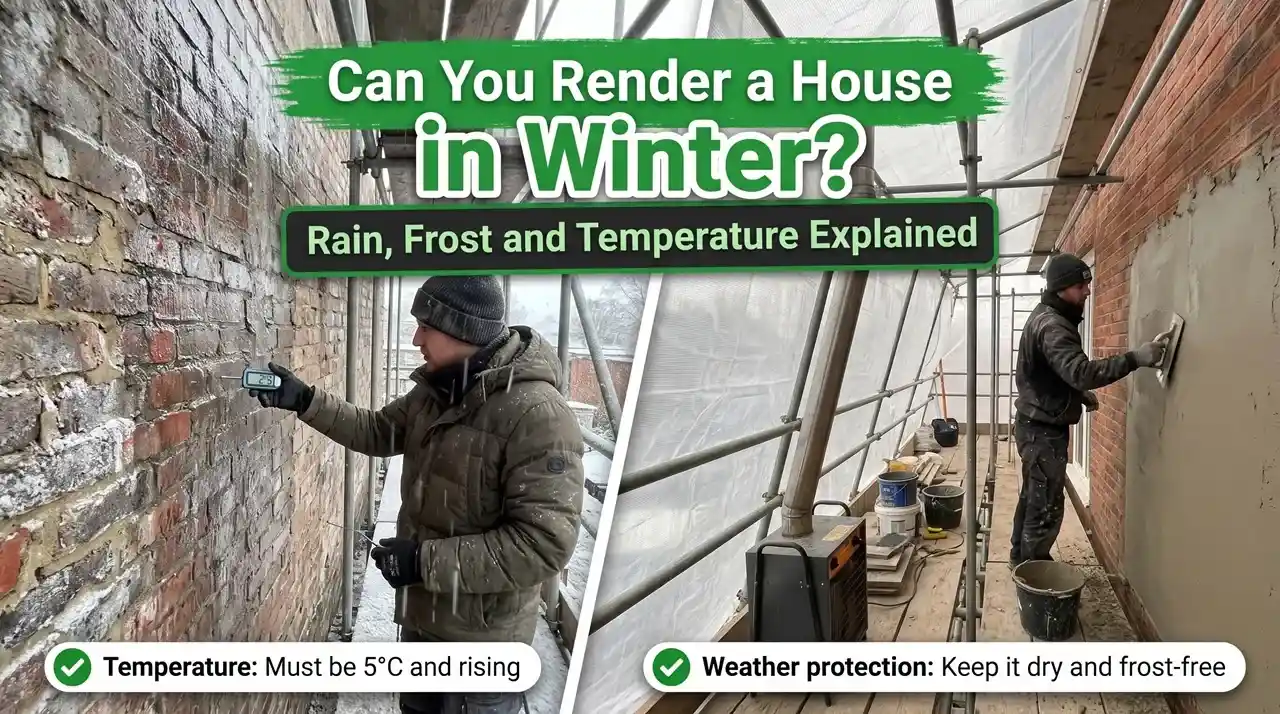
Can you render in winter? Yes, sometimes, but only when the weather and the render system allow it. Many systems specify a minimum application temperature of around 5°C, the wall must be suitable, and fresh render must be protected from frost and rainfall while it sets and cures. A mild afternoon alone does not make conditions suitable.
Overnight temperatures, forecast rainfall, wall moisture and curing requirements must all be checked too. This guide covers feasibility and timing: temperature, rain, frost, render types, protection and postponement.
Can You Render in Winter?
Winter itself neither rules rendering out nor approves it. What matters is whether the chosen days give the render a fair chance to set and cure: temperatures within the product’s limits, a wall that is not frozen or saturated, and a forecast without frost or driving rain during curing. In short, can you render in winter? Yes, when those checks pass.
That is why two houses rendered in the same week can have different answers, and why one elevation may start while another waits. North-facing walls stay damp longer, and a single cold night during curing can undo a perfect application day.
What Is the Minimum Temperature for Rendering?
Most standard systems set a lower limit around 5°C, but that hides four checks.
Air temperature. Air temperature at application must be within range, and for many systems that means 5°C or above.
Wall temperature. A wall can stay colder than the air, so check the surface itself: it must not be frozen.
Forecast. Temperatures must stay suitable throughout curing, so the overnight forecast matters as much as the application day.
The 5°C figure. Weber publishes a 5°C minimum, and K Rend gives a 5°C to 35°C range for cementitious and synthetic products, but neither covers every formulation.
Can You Render a House When It’s Raining?
Can you render in the rain? Exposed application during rainfall is generally unsuitable: rain can wash fresh render, disturb its finish and leave colour inconsistent. Before work starts in an unsettled spell, a professional rendering assessment can confirm whether the wall, moisture and forecast together allow application.
Rain nearby differs from rain reaching the wall. Where proper protection keeps the elevation dry, work may be possible despite wet weather elsewhere, but a saturated background is still a reason to wait: a wall that looks dry on the surface can hold moisture beneath, weakening adhesion and encouraging limebloom.
What Happens If Fresh Render Freezes?
Fresh render is most vulnerable before it has gained strength. Cement-based coats harden through hydration, needing water and a suitable temperature, while thin-coat finishes dry by evaporation. If water inside the fresh coat freezes before either process has progressed, it expands and disrupts the developing structure, weakening the bond.
Damage may show as cracking, crumbling, debonding or sections coming away from the wall, and at worst the system fails early. That does not mean every frost destroys a whole elevation: timing, severity and protection all matter, and fully cured render faces winter well. But premature failure shortens a system’s life, which is why our guide to how long render lasts separates finish life from system life.
Do Different Render Types Behave Differently in Winter?
Yes, but only in how they set and what they tolerate.
Cement and Monocouche
Cement-based coats, including monocouche, harden by hydration and need time and temperature. Most monocouche data sheets set a 5°C minimum, and cold extends curing, so a late coat may still be vulnerable overnight.
Silicone and Acrylic Thin-Coat Systems
Thin-coat silicone and acrylic finishes dry by evaporation, so cold and humidity slow them directly. Guidance commonly requires above 5°C and humidity below 85% at application and for 48 hours after, and damp base coats can cause wash-off.
Lime Render
Lime render is the most cautious case. It sets by carbonation, needs days of damp, and requires longer protection in cold weather. Some lime guidance sets higher minimum temperatures, so modern-system rules must never be assumed to apply.
Specialist Winter-Compatible Systems
Some systems are formulated for colder work, with winter products applied from as low as 1°C, and approved accelerators can shorten setting times. An accelerator is not antifreeze: the render can still freeze, and only the data sheet can confirm its limits.
How Do Renderers Protect Exterior Walls in Cold Weather?
Protection turns a borderline forecast into a workable one, but it must be planned before application.
- Hang scaffold sheeting clear of the wall to keep rain and frost off without touching fresh render.
- Work elevations in sequence so each is protected before nightfall.
- Keep gutters and temporary downpipes working so water runs clear of the elevation.
- Leave protection in place for the full required period; 48 hours is a minimum for some systems, not proof that curing is complete.
Sheeting is rain and frost protection, not waterproofing: it cannot rescue a saturated wall or substitute for suitable temperatures.
When Should Winter Rendering Be Postponed?
When any row below applies, waiting is usually the honest answer.
| Conditions | General Consideration |
| Mild, dry conditions within product limits | Rendering may be possible |
| Cold wall despite mild air temperature | Check substrate temperature first |
| Frost expected during curing | Postpone unless protection maintains required conditions |
| Heavy rain reaching the wall | Avoid exposed application |
| Saturated masonry | Assess and allow suitable drying |
| Suitable protected enclosure | Work may be feasible if requirements can be maintained |
This table is general guidance only. Every job must still be checked against the chosen data sheet.
Planning External Rendering During Winter in Durham
Planning a winter rendering job in Durham means planning around uncertainty. Dates may need to move at short notice, working days are shorter, and north-facing elevations can stay damp after rain. A realistic programme builds in spare days for weather, rather than fixing a finish date the forecast cannot support.
The wall itself needs the same flexible approach. Older solid-walled properties around County Durham may carry lime mortar, stone masonry or earlier coatings, each affecting suction, drying and system choice. That is why Plasterers Durham assesses the wall and its existing coatings before recommending a system or start date.
Frequently Asked Questions
Answers to the questions homeowners ask most, starting with: can you render in winter?
Can You Render Below 5 Degrees?
Generally no with a standard system. The 5°C figure is a minimum, not a target: the wall must also be suitable, with no frost expected during curing. Specialist systems have their own lower limits, so always check the data sheet.
Does Render Take Longer to Dry in Winter?
Yes. Cold air slows evaporation, cement hydration proceeds more slowly, and damp backgrounds absorb less, so drying and curing take longer. North-facing elevations are slowest, which is why winter programmes need spare days.
Can Silicone Render Be Applied in Winter?
Yes, but only within its data sheet limits. Silicone and acrylic thin coats usually need above 5°C and humidity below 85% at application and for 48 hours after, and damp base coats can still cause wash-off.
Is Lime Rendering Suitable for Winter?
It can be, but it needs longer protection than modern systems, and cold, damp conditions slow carbonation. Lime work is often postponed to milder weather, and modern-system rules must never be assumed to apply.
Is It Better to Render a House in Spring or Winter?
Spring generally offers longer, more reliable windows, with lower frost risk. Winter can still work in mild, dry spells with proper protection, but the decision should follow the forecast and the wall, not the month.
Winter Rendering: Proceed or Postpone?
So, can you render in winter? It comes down to five checks: air temperature, wall temperature, forecast, background moisture and the product’s limits, with protection in place for the full curing period. The K Rend winter working guide sets out the same discipline from a manufacturer’s side: plan ahead, check the forecast, respect the temperature range and keep surfaces protected.
If you are considering rendering this winter, Plasterers Durham can assess your walls across Durham and County Durham and advise whether to start or wait.