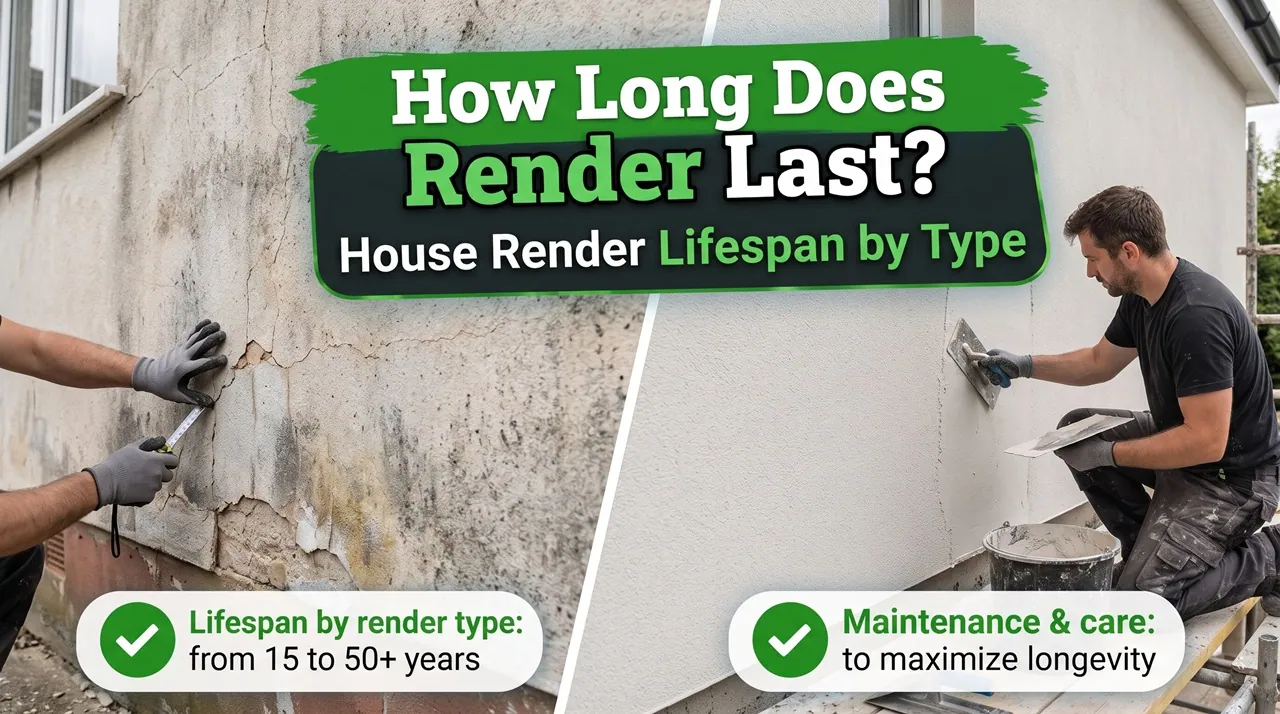
How long does render last? House render can last from around a decade to several decades, depending on the render system, the condition of the wall, the quality of installation, weather exposure and maintenance. Well-installed modern silicone systems are commonly expected to last around 20-30 years or more, while compatible lime render can remain serviceable for many decades with appropriate maintenance. All figures here are indicative, not guarantees.
How Long Does Render Last on a House?
The first distinction is what “lasts” means. A finish can look tired long before the system has failed, while a neat coating can hide debonding or trapped moisture. The real question is whether the system still protects the wall, sheds water and stays bonded.
That is also why published figures disagree: one guide counts the life of the finish, another the life of the full system, and some quote warranty periods rather than service life. For an existing wall, a hands-on check tells you more than any published figure, and local external plastering services in Durham can assess whether a coating is sound, repairable or at the end of its life.
House Render Lifespan by Type
The question of how long does render last has no single answer, because each system ages differently. The table below sets out indicative external render lifespan ranges, matching the spread shown in guides such as the Homebuilding house rendering guide.
| Render Type | Indicative Lifespan | Key Lifespan Factors |
| Silicone | Often around 20-30+ years | Installation, moisture control, cleaning |
| Monocouche | Often around 20-30 years | Cracking, detailing, exposure |
| Sand and cement | Highly variable | Repainting, cracking, substrate condition |
| Lime | Many decades on suitable traditional walls | Limewashing, compatible repairs, breathability |
| Acrylic | Often around 20-30 years | Full system quality and maintenance |
| Mineral / silicate | Often around 20-30 years | System specification and maintenance |
Silicone Render
Silicone render is a thin-coat, water-repellent finish over a base coat and reinforcing mesh. Its flexibility helps it cope with small substrate movement, and its self-coloured surface needs no painting. Correctly installed and gently cleaned, a silicone render lifespan of around 20-30 years or more is commonly expected.
Monocouche Render
Monocouche is a through-coloured, one-coat cement-based render with a scraped finish. The colour runs through the coat, so no paint layer can peel, but the system is less flexible than silicone, and hairline cracking is more likely where the substrate moves or detailing is poor. On a stable substrate with good detailing, a monocouche render lifespan of around 20-30 years is reasonable.
Sand and Cement Render
Sand and cement render is the traditional rigid system, usually finished with masonry paint. UK guides disagree sharply on its lifespan, some quoting around 7-15 years and others 20 years or more, because paint and base coat age at different rates. Repainting and prompt crack repair make the biggest difference to a cement render lifespan.
Lime Render
Lime render is the breathable, traditional finish for solid-walled and period properties, letting moisture vapour pass through the wall rather than trapping it. On compatible traditional walls, with limewashing and compatible local repairs, a lime render lifespan of many decades is realistic, although it is not a fit-and-forget system.
Acrylic and Mineral Render
Acrylic and mineral renders are both thin-coat systems over a base coat and mesh. Acrylic finishes are flexible and impact resistant, while mineral or silicate finishes are highly breathable and usually recoated rather than replaced. Installed correctly, both commonly sit in the 20-30 year range.
Pebbledash, or roughcast, is a finish rather than a separate system: its lifespan depends mainly on the underlying render coat and the bond of the aggregate, and isolated patches can usually be repaired.
What Affects How Long Render Lasts?
The render system sets the starting point, but the wall and the work decide the outcome. Sound, well-prepared masonry gives the coating something to bond to, while a cracked or unstable substrate passes its movement into the finish. The base coat, reinforcing mesh, beads and movement joints protect the system at its weakest points, so render durability depends as much on these details as on the product itself.
Exposure then does its work. Driving rain, frost and freeze-thaw cycles test the surface, shaded north-facing elevations stay damp longer and grow algae, and a wall under a leaking gutter is wetted far more than the weather alone would explain.
Why Can Render Fail Earlier Than Expected?
Water getting behind the render is the most common reason a system falls short of its expected life. It enters through cracks, open junctions, defective gutters and downpipes, damaged sills and failed flashings, then sits trapped between coating and wall. Once trapped, frost can blow the bond, damp staining follows, and sections turn hollow or loose.
Poor installation shortens life the same way: inadequate preparation, missing or misplaced reinforcement, poor edge detailing, unsuitable conditions and insufficient curing all weaken the bond before the weather has started on it.
How Does Maintenance Affect Render Lifespan?
Render maintenance is system-specific, and the wrong treatment can do as much harm as neglect.
Sand and cement. Periodic repainting and prompt crack repair keep the coating weatherproof.
Lime. Limewashing and compatible local repairs maintain breathability. Cement patches on lime render trap moisture and should be avoided.
Silicone. Usually the lowest maintenance of the group, needing only gentle cleaning and periodic inspection.
Monocouche. Cleaning and local repair where damaged, with cracks dealt with before water enters.
Aggressive pressure washing is not safe for every finish and can damage some surfaces, so gentle cleaning is the safer starting point.
What Are the Signs That Render Needs Replacing?
One hairline crack does not mean a house needs re-rendering. These are the clearest signs render needs replacing when widespread or returning despite repair.
- Cracking appears across whole elevations rather than in one isolated spot.
- Cracks return in the same places after previous repairs.
- Several areas sound hollow when tapped, showing debonding.
- Sections are loose, bulging or crumbling away from the wall.
- Water keeps getting in despite gutter and flashing repairs.
- Large areas of failed coating or repeated patch failures are visible.
Any one alone may still be repairable, but several together usually point to a system at the end of its service life.
Can Old Render Be Repaired Instead?
Local damage does not always mean the whole house needs re-rendering. A single cracked panel or damaged corner can often be repaired, and a sound system with a tired finish may only need cleaning or recoating. Where failure is widespread, patching a debonded system rarely lasts, and replacement is the more honest option. Our guide to rendering over existing render explains when an old coating can stay and when it must come off.
Which Type of Render Lasts the Longest?
There is no single winner. Suitable lime render performs exceptionally well on traditional masonry, while a modern silicone system offers long life with low maintenance on a suitable modern or prepared substrate. The longest-lasting system is generally the one that suits the wall, is installed correctly, manages moisture and is maintained appropriately.
A warranty period is not a lifespan. A system can remain serviceable well beyond its warranty, while unsuitable installation or substrate problems can cause early failure inside it.
What About Older Homes in Durham?
Older homes in Durham and County Durham often have solid masonry, stone walls and lime mortar, sometimes with later cement repairs. On these walls, breathability matters, because a rigid, impermeable coating can trap moisture the original wall was built to release. Not every older home needs lime render, but the system must suit the wall beneath it, which is why Plasterers Durham assesses the existing masonry and previous coatings before recommending a finish.
How Can You Help Render Last Longer?
Most habits that extend render life are unglamorous: keep gutters and downpipes clear and watertight, repair cracks promptly before water enters, clean gently, and inspect the render after severe weather. Small, early repairs protect the bond the whole system depends on.
If your render shows widespread cracking, hollow areas or recurring damp staining, Plasterers Durham can assess whether repair or replacement is right for your home in Durham or County Durham. So, how long does render last? For most homes, the answer is measured in decades when the system suits the wall and is looked after, not in a single published number.
Frequently Asked Questions
The questions below cover the points homeowners most often ask about render lifespan, including the question of how long does house render last in practice.
How Long Does Render Last on a House?
House render can last from around a decade to several decades. Silicone systems commonly last around 20-30 years or more, lime render can last many decades on compatible walls, and sand and cement render varies widely with repainting and repair. The deciding factors are the system, the wall, the installation, exposure and maintenance.
How Long Does Silicone Render Last?
Silicone render commonly lasts around 20-30 years or more when correctly installed and maintained. Its flexible, water-repellent finish resists cracking and needs no painting, although gentle cleaning and inspection help it reach the upper end of that range.
How Long Does Monocouche Render Last?
Monocouche render commonly lasts around 20-30 years on a stable substrate with good detailing. Hairline cracking is its main weakness, so wall movement or poor detailing can shorten its life, while prompt crack repair helps it last considerably longer.
How Long Does Cement Render Last?
Cement render lifespan varies more than any other common system. Some UK guides quote around 7-15 years and others 20 years or more, because the paint wears out faster than the coat beneath it. With repainting and prompt crack repair, a well-applied cement render can remain serviceable for many years.
How Long Does Lime Render Last?
Lime render can last for many decades on compatible traditional masonry when limewashed and repaired with compatible materials. Its lifespan depends more on maintenance and compatibility than on any fixed number, and cement repairs on lime render can shorten it.