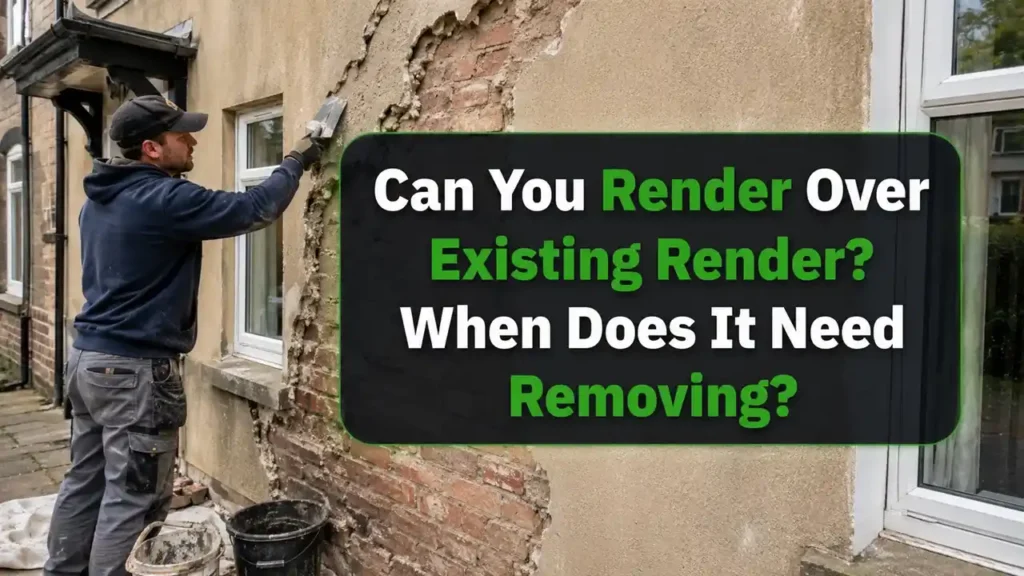
Can you render over existing render? Sometimes, but only when the existing surface is sufficiently sound, well bonded and compatible with the proposed system. Loose, hollow, crumbling or extensively damaged render should not simply be hidden beneath another coat.
Even render that looks sound from a distance may have poor adhesion, old paint, moisture problems or unknown layers underneath. The existing wall therefore needs assessing before deciding whether to repair it, retain and prepare it, or remove the old render.
Can You Render Over Existing Render?
The answer depends on the substrate, meaning the surface that will support the new render. If the existing render becomes part of that substrate, the new system ultimately relies on the old render remaining firmly attached to the masonry beneath it.
This is why can you render over existing render cannot be answered with a universal yes. Weber UK currently advises against routinely applying new render over old systems because important factors such as bond strength, thickness, quality and previous coatings may be uncertain.
In suitable circumstances, sound existing areas may sometimes be retained as part of a professionally specified refurbishment. The proposed product or render system must still permit that background and the necessary preparation.
The First Decision Is Whether the Old Render Is Actually Sound
An exterior wall can look reasonably intact while sections underneath have already started to separate. Assessment therefore goes beyond checking its colour or surface finish.
A plasterer may consider the condition of the render, crack patterns, adhesion, previous coatings, signs of moisture and the masonry beneath accessible failed areas.
What Does Hollow or Blown Render Mean?
Blown or hollow render has lost some of its effective bond with the layer or wall behind it. One possible indicator is a noticeably hollow sound when areas are assessed, although tapping alone should not be treated as a complete diagnosis.
If extensive areas have detached, putting a new finish on top does not restore that failed connection. Weber’s current technical guidance specifically includes checking for detached areas and assessing adhesion before any additional render is considered.
Homeowners arranging external plastering in Durham should therefore expect the background to influence the proposed finish rather than choosing a new render solely by appearance.
Three Different Outcomes Are Possible
Re-rendering a house does not always mean choosing between leaving everything untouched and stripping every wall completely. The condition can justify different approaches across the same elevation.
1. Localised Repair
Where failure is restricted to small areas, damaged material may be removed back to a sound background and repaired.
This can be more proportionate than stripping a complete elevation when the surrounding render remains stable. Matching the old texture and finish may still need consideration.
2. Retain Sound Areas and Prepare Them
Where assessment and the proposed system support it, stable sections may sometimes remain. Preparation can involve cleaning, addressing defects and using the appropriate compatible base or preparation system.
The important point is that preparation does not make an unstable background stable. It prepares a substrate that has already been judged suitable.
3. Remove the Existing Render
Removal becomes more likely when deterioration is widespread, adhesion is poor or the existing layers cannot confidently support the proposed build-up.
This may apply to extensive blown render, loose or friable areas, widespread failure or situations where incompatible coatings and previous work make the background unsuitable.
When Is Removing Old Render More Likely?
The scale and pattern of deterioration matter more than one isolated blemish.
| Existing Condition | Likely Consideration |
| Firmly bonded and generally sound | Assess system compatibility and preparation |
| Small isolated damaged areas | Local repair may be possible |
| Hollow or blown sections | Failed areas are likely to need removal |
| Widespread cracking | Investigate the cause before covering |
| Loose or crumbling render | Removal is generally more appropriate |
| Painted render | Coating and adhesion require separate assessment |
| Damp or stained render | Find and address the moisture source first |
| Traditional lime render | Check compatibility with the wall construction |
This is a decision guide rather than a substitute for inspection. A wall can contain more than one of these conditions at the same time.
Cracked Render Needs a Cause, Not Just a Covering
Not every crack means all the render has failed. Fine isolated surface cracking can be very different from a recurring crack extending through several layers or a crack associated with wall movement.
Small and Localised Cracks
Some minor defects can potentially be repaired within a suitable render system. Weber, for example, publishes specific repair guidance for certain cracks in its own monocouche products.
The repair still needs to suit the existing material and condition.
Repeated or Significant Cracking
A crack that repeatedly returns, widens or appears alongside hollow render requires more investigation. Covering movement with another layer can simply transfer the problem through the new finish.
Reinforcement may form part of a professional specification, but it should not be used as a substitute for understanding why the wall is cracking.
Can You Render Over Painted Render?
Paint changes the decision considerably because the new render may end up depending on the strength of the paint bond rather than bonding properly with the original masonry or render.
Weber’s current guidance treats painted backgrounds as unsuitable for direct rendering within its described systems and requires the paint to be removed before the relevant preparation is carried out.
That does not mean every product from every manufacturer follows an identical specification. It means the coating must be identified and the proposed render manufacturer’s instructions checked rather than assuming a primer automatically solves the issue.
Poorly attached paint, flaking coatings, dirt and organic growth can all create weak intermediate layers.
Does Reinforcing Mesh Make Old Render Suitable?
No. Reinforcing mesh can be useful within render systems, particularly as part of a reinforced base coat or around areas where a specified system requires additional crack control.
It cannot recreate the bond between blown render and the wall underneath.
Think of the wall as a series of connected layers. If the weakest layer is already separating, strengthening a layer above it does not remove the original weak point. Weber likewise warns that extra render layers add load to the layers beneath, making the quality of the existing bond important.
Damp Render Should Be Investigated Before It Is Covered
Staining or dampness is another reason not to rush directly into re-rendering. New render should not simply conceal an active moisture source.
Problems can be associated with leaking gutters or downpipes, defective pointing, cracks around openings, roof or flashing defects and unsuitable previous coatings. The actual source should be established before the wall finish is specified.
Persistent moisture can also affect adhesion and the behaviour of the masonry underneath. This is particularly important where several previous repairs or coatings have already been applied.
Plasterers Durham’s rendering services cover exterior wall rendering, but the appropriate preparation should follow the actual wall condition rather than assuming every existing finish can stay in place.
What About Lime Render and Older Durham Properties?
Older properties in Durham and County Durham may have solid brickwork, stone construction or lime-based render rather than modern cavity-wall construction.
These walls may have been designed around more vapour-permeable materials, so compatibility deserves particular attention. A hard or relatively impermeable modern system should not automatically replace an older lime finish simply because it is newer.
At the same time, age alone does not prove that lime is required. Previous alterations may mean several different materials are already present.
A suitable specification should therefore consider the original masonry, existing render and moisture behaviour of the wall before selecting a replacement system.
What Happens Before a New Finish Is Chosen?
A good assessment works backwards from the wall rather than forwards from a favourite render product.
The sequence is broadly:
- Identify the existing background. Establish what material and coatings appear to be present.
- Assess adhesion and deterioration. Determine whether failure is isolated or widespread.
- Investigate cracks and moisture. Address significant underlying causes before hiding them.
- Decide what can remain. Remove failed material where necessary rather than automatically stripping everything.
- Check compatibility. Confirm that the proposed system is suitable for the remaining substrate and follows manufacturer guidance.
Only after these questions have been answered does surface preparation make sense.
Weber’s technical advice reinforces this principle by noting that render needs appropriate suction and mechanical key to develop an effective bond.
Frequently Asked Questions
Can You Render Directly Over Existing Render?
Sometimes a sound existing surface can potentially form part of a suitable substrate, but it should not be assumed. Condition, adhesion, existing coatings and the proposed render system all need checking first.
Do You Have to Remove Old Render Before Re-Rendering?
Not always. Small failed sections may be removed and repaired while sound areas remain. Widespread deterioration or poor adhesion can make more extensive removal necessary.
How Do You Know If Render Has Blown?
Blown render has partly lost its bond with the background and may sound hollow during professional assessment. The extent of detachment should be considered alongside cracks, moisture and substrate condition.
Can You Render Over Hollow Render?
It is generally not appropriate simply to cover detached render because the weak bond remains underneath the new finish. Failed areas normally need addressing first.
Can Cracked Render Be Rendered Over?
That depends on the crack. Minor isolated cracking may be repairable, while significant or recurring cracks should have their cause investigated before another finish is applied.
Can You Render Over Painted Render?
Direct application should not be assumed to be suitable. The type, condition and bond of the paint need assessment, and manufacturer requirements for the proposed system should be followed.
Can Part of a Rendered Wall Be Repaired?
Yes, local repairs may be possible where deterioration is confined to limited areas and the surrounding render remains sound. Matching texture and finish can influence the final appearance.
Can Silicone Render Go Over Old Render?
Not simply because it is silicone render. The complete system must be compatible with the existing background, and the manufacturer’s substrate and preparation requirements should determine whether it is suitable.
Assess the Existing Wall Before Deciding What to Remove
The practical answer to can you render over existing render is that the existing finish must first be suitable to support the new system. Sound areas may sometimes be retained after appropriate assessment and preparation, while hollow, loose, crumbling or extensively failed render should not simply be covered.
Compatibility matters even where the wall appears sound. The proposed render must suit the existing substrate, previous coatings and condition of the wall. For further technical context, the Weber UK guidance on existing render explains why factors such as bond strength, existing treatments and overall render quality need to be considered before applying another system.
Plasterers Durham can assess rendered exterior walls across Durham and County Durham to determine whether local repairs, preparation of suitable existing areas or more extensive render removal may be appropriate.
The aim is to create a stable, compatible background for the new finish rather than retaining old render simply to avoid removing it.