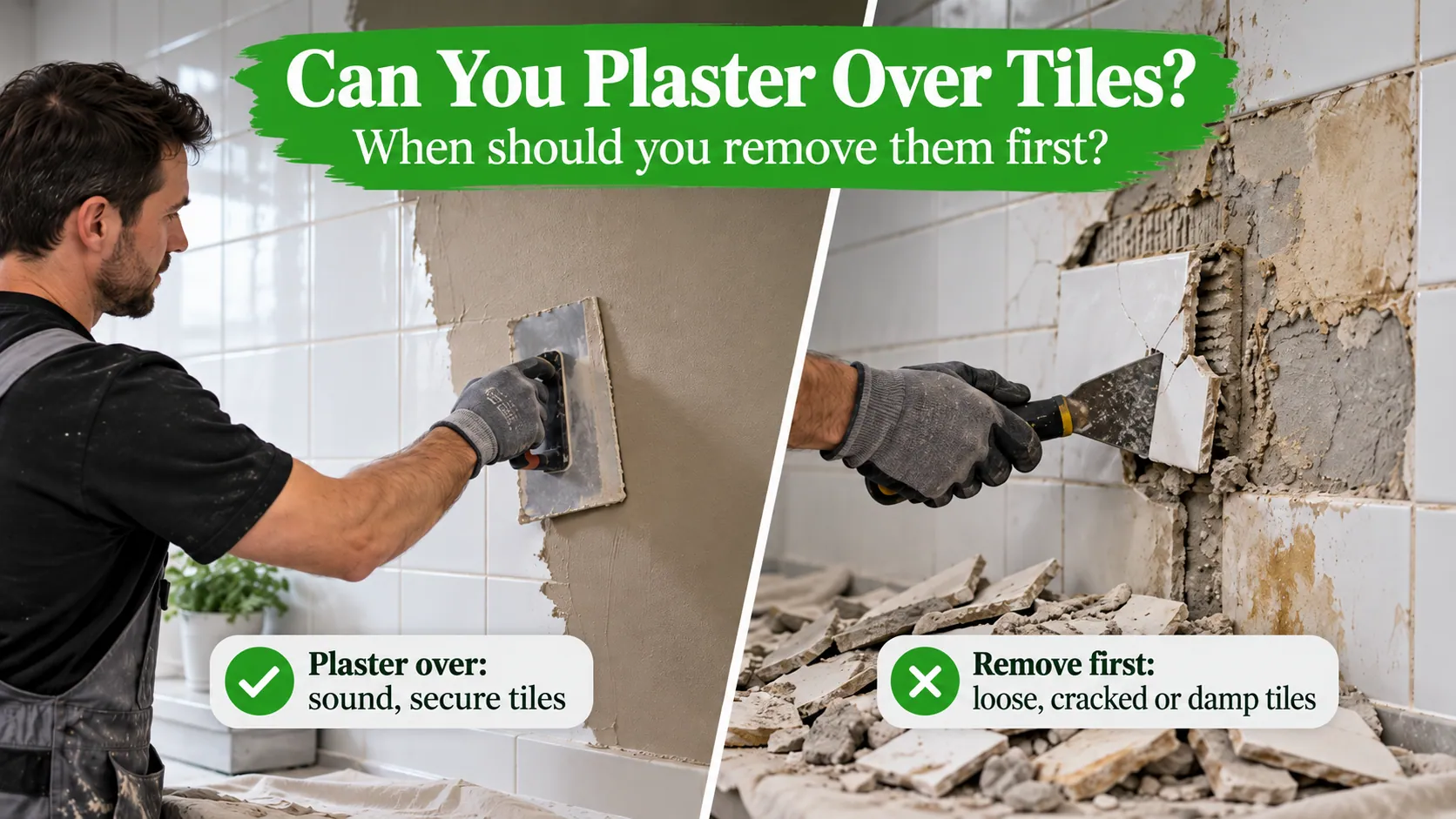
Can you plaster over tiles? Sometimes, provided the tiles are firmly bonded, dry, stable and suitable for the plaster system being used. The important limitation is that the new finish is only as reliable as the tiles, tile adhesive and wall behind it.
Loose, hollow, cracked or moisture-affected tiles should not simply be concealed beneath a skim. In those situations, removing the tiles and assessing the original wall may provide a more reliable starting point.
The Weakest Layer Decides Whether the Tiles Can Stay
A tiled wall is not one surface. It is a series of connected layers:
wall or plasterboard → tile adhesive → tile → preparation system → new plaster
That relationship is the key to deciding whether plastering over tiles makes sense.
A bonding system may create good adhesion between new plaster and the face of a prepared tile, but it cannot repair a tile that is already separating from the adhesive behind it.
If one of the lower layers fails, everything added above it is affected.
This is why Plasterers Durham’s internal plastering and wall repair services assess the existing background before deciding whether a skim, local repair or more substantial preparation is appropriate. The live service page confirms that internal work includes skimming, patch repairs and full replastering.
Three Checks Matter Before Keeping the Existing Tiles
The decision is easier if the wall is considered in three separate stages rather than asking only whether plaster will stick to ceramic.
1. Are the Tiles Secure?
Tiles should not move, bulge or show obvious signs of detachment.
Cracked grout, tiles pulling away from the wall, visible movement and widespread hollow areas can suggest that the existing tiled layer is no longer a dependable background.
A hollow sound can help identify an area that deserves closer inspection, but tapping alone should not be treated as a complete professional assessment.
If the tile bond is uncertain across a substantial area, keeping the tiles means keeping that uncertainty beneath the new plaster.
2. Is the Wall Dry and Suitable?
Moisture changes the decision.
Water behind bathroom tiles, failed seals, leaking pipework or another damp problem should be investigated before the wall is covered. New plaster is not a remedy for moisture trapped behind a tiled surface.
The same applies where the wall behind the tiles is damaged plasterboard, loose plaster or deteriorated masonry.
3. Will the Extra Wall Build-Up Cause Problems?
Plastering over existing tiles retains the thickness of the tiles and adhesive, then adds preparation and plaster on top.
That can matter around sockets, switches, door architraves, window reveals, skirting boards, worktops, pipework and bathroom fittings.
A tiled wall can therefore be physically sound but still be a poor candidate for over-plastering because the finished wall would project too far forward.
Can You Plaster Over Glazed Ceramic Tiles?
Potentially, but standard finishing plaster should not simply be applied directly to an untreated glazed surface.
Glazed ceramic tiles are smooth and have very little suction, so the plaster system needs an appropriate method of creating adhesion.
British Gypsum’s current White Book specifically lists ceramic tiles as backgrounds requiring preparation and pre-treatment with a suitable bonding agent before its gypsum plaster systems are applied. It also says surfaces should be clean, dry and suitable to receive plaster.
That does not mean one primer is suitable for every plaster and tile combination. The preparation should follow the requirements of the complete plaster system being used.
The Plasterers Durham guide explaining when bonding plaster is used on difficult backgrounds provides additional background on low-suction surfaces without making bonding plaster the main subject of this article.
Bathroom Tiles Need a Different Decision from a Dry Wall
Bathrooms introduce humidity, splashing and, in some areas, direct water exposure.
A tiled wall away from the shower or bath may be assessed differently from a wall that forms part of a regularly wetted enclosure.
Dry Bathroom Walls
On a dry internal bathroom wall, firmly bonded tiles may sometimes be considered for over-plastering after the correct assessment and preparation.
Ventilation, existing moisture damage and tile stability still matter.
Shower and Direct Wet Areas
Standard gypsum finishing plaster should not be treated as a waterproof wall finish.
If the area receives frequent direct water, the complete wall system needs to be suitable for that environment. Simply covering existing shower tiles with an ordinary skim does not create a waterproof specification.
This distinction is more useful than treating every bathroom wall as though it has the same moisture exposure.
Kitchen Tiles Bring Grease and Junction Details into the Decision
Kitchen splashbacks often look like an easy surface to cover, but contamination can affect adhesion.
Cooking grease, cleaning residues and accumulated dirt must be considered before any bonding system is applied. The wall also needs to be assessed around worktops, units, sockets and switches.
In a full kitchen renovation, removing the splashback may make more sense where electrical work, new units or changes to the worktop are already planned.
Where only a limited wall area is being refurbished and the existing tiles are demonstrably stable, retaining them may sometimes avoid unnecessary disruption.
The correct choice follows the renovation scope, not simply the fact that the room is a kitchen.
What Happens If You Remove the Tiles First?
Removing tiles gives access to the original wall, but it does not guarantee that the surface underneath will immediately be ready for a skim.
Tile removal can expose:
- adhesive ridges and hard patches
- loose or blown plaster
- damaged plasterboard paper
- cracks and old repairs
- holes or localised missing plaster
- exposed brickwork or blockwork
The amount of making good depends on what is uncovered.
Where damage is relatively shallow, local repairs and levelling may be enough before using professional wall skimming services to produce the final decoration-ready surface.
More extensive damage may require a backing coat, replacement plasterboard or wider replastering rather than trying to hide deep irregularities with finishing plaster.
What About Tile Adhesive Left on the Wall?
Old adhesive does not always have to be removed back to completely bare masonry.
Its condition matters more than its mere presence.
Loose, friable or poorly bonded adhesive should not simply be covered. Firmly attached material may sometimes form part of a repair and levelling specification, depending on its thickness, the substrate beneath it and the finish required.
Very uneven remnants can also make it difficult to create a flat wall without additional preparation.
This is another situation where deciding how to repair the background is more useful than applying a universal rule that all adhesive must stay or all adhesive must go.
Could Plasterboard Be Used Instead?
Plasterboard can form part of an alternative wall solution, but boarding over existing tiles creates another layer rather than solving an unstable tiled background automatically.
Any fixing method has to be suitable for the actual structure behind the tiles. The additional thickness can also make junctions around fittings, frames and services more complicated.
Plasterers Durham’s drylining and plasterboard installation service is relevant where the existing wall condition means a board-based solution is being considered rather than direct wet plastering.
The choice should follow the wall construction and finished dimensions rather than treating plasterboard as a shortcut around failed tiles.
Plaster Over the Tiles or Strip Them Back?
Neither approach is automatically correct.
| Factor | Keep and Plaster Over Tiles | Remove Tiles First |
| Tile bond | Remains part of the finished system | No longer a dependency |
| Underlying wall visibility | Limited | Wall can be inspected |
| Disruption | Usually lower initially | Usually greater |
| Wall thickness | Increases | Existing tile build-up removed |
| Wall repairs | May be avoided initially | Often needed after removal |
| Uneven tiles | Can complicate levelling | Original background can be repaired |
| Moisture investigation | More limited | Greater access to the wall |
| Best suited to | Sound, stable, suitable tiled backgrounds | Uncertain, damaged or unsuitable tiled walls |
The table is a decision aid rather than a substitute for checking the actual wall.
Removal becomes more attractive where the tiles are loose, significantly uneven, moisture-affected, built up in multiple layers or hiding a wall that needs investigation.
Keeping the tiles may be reasonable where their bond is dependable, the room conditions are suitable and the extra thickness will not interfere with the finished room.
What Do Current Plaster Manufacturer Guidelines Say?
Manufacturer guidance reinforces why preparation needs to match the plaster system rather than relying on a generic rule.
The current British Gypsum White Book guidance on plaster backgrounds specifically addresses ceramic tiles and other smooth, low-suction backgrounds. It requires suitable preparation and pre-treatment and also highlights the need to consider background strength, bonding properties, moisture and overall suitability before plastering. British Gypsum
For homeowners, the practical lesson is not that every tiled wall should use one named product. It is that the plaster, preparation system and existing substrate need to be compatible with each other.
Frequently Asked Questions
Can You Plaster Directly Over Tiles?
You should not normally apply finishing plaster straight onto an untreated glazed tile surface. Sound tiles can sometimes remain, but they need appropriate preparation and a compatible bonding system.
Can You Skim Over Bathroom Tiles?
Potentially on suitable dry bathroom walls. Areas exposed to regular direct water need a complete wall system designed for that environment rather than relying on standard skim plaster as waterproofing.
Should You Remove Tiles Before Plastering?
Not always. Removal is more appropriate where the tile bond is uncertain, the wall needs inspecting or repairing, moisture is present, or additional wall thickness would create problems.
Can Loose Tiles Be Plastered Over?
They should not simply be covered. If a tile is loose, the new plaster remains dependent on that unstable layer underneath.
Can You Plaster Over Tile Adhesive?
Some firmly bonded adhesive may be repairable or prepared as part of the wall background. Loose material, heavy ridges and an uneven substrate may require more extensive preparation.
Does Plastering Over Tiles Make the Wall Thicker?
Yes. The existing tiles and adhesive remain, and the preparation and plaster add another layer. This can affect sockets, switches, frames, worktops and other adjoining finishes.
What Happens If Tile Removal Damages the Plasterboard?
The answer depends on the extent of the damage. Localised areas may be repairable, while badly damaged board can require replacement before the final finish is applied.
Decide What the Finished Plaster Will Actually Be Relying On
The practical answer to can you plaster over tiles is that the surface may sometimes be retained, but only when the complete build-up beneath the new plaster is sufficiently stable.
A well-prepared tile face does not compensate for failed adhesive, damaged plasterboard, moisture problems or loose plaster behind it.
For Durham and County Durham homeowners, Plasterers Durham can assess tiled kitchen, bathroom and utility-room walls and determine whether retaining the tiles, removing them and repairing the wall, or using another internal wall system is the more appropriate route.
The objective should be a sound background that supports the finished plaster independently and reliably, rather than keeping old tiles simply because removing them would create more preparation work.