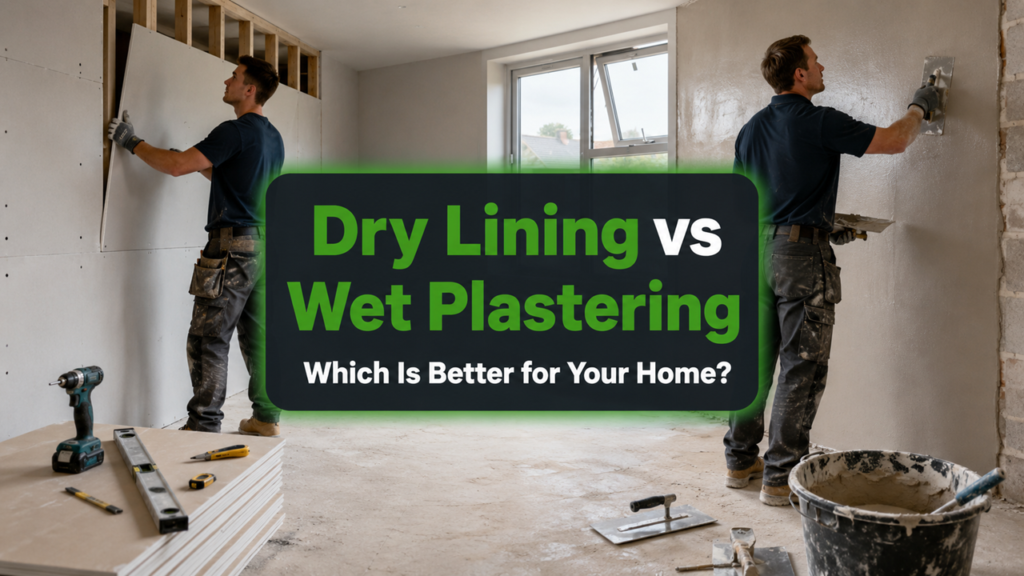
The right choice between dry lining vs wet plastering depends on the wall, the age of the property and what the finished room needs to achieve. Dry lining often suits projects that need faster wall levelling, specialist plasterboard, insulation or space for services. Wet plastering may suit sound masonry where a solid, continuous finish and minimal loss of room space are priorities.
Neither method is universally better. Plasterers Durham recommends assessing the wall construction, moisture condition, room dimensions and future use before choosing a system for a home in Durham or County Durham.
Begin With the Wall You Already Have
The existing background often narrows the choice before appearance or project speed is considered.
Bare Blockwork in an Extension
Both dry lining and wet plastering may work over new blockwork. Plasterboard can help move the programme forward with fewer wet coats, while traditional plaster can create a solid finish directly over a properly prepared background.
Uneven Masonry During Renovation
Plasterboard can create a straight surface over irregular brickwork by using adhesive dabs, battens or framing. Wet plastering may also level the wall through suitable undercoat and finish coats, but the preparation depth and condition of the masonry must be assessed.
A Traditional Solid Wall
Older walls may contain lime plaster, stone or solid brickwork designed to manage moisture differently from modern cavity-wall construction. Standard plasterboard or dense gypsum plaster should not be added automatically without considering material compatibility and vapour movement.
Dry Lining vs Wet Plastering: Two Routes to a Finished Wall
Dry lining involves fixing plasterboard to masonry, timber battens, metal framing or studwork. Wet plastering involves applying suitable plaster coats directly to a prepared brick, block, stone or masonry surface.
| Part of the Work | Dry Lining | Wet Plastering |
| Main Material | Plasterboard or specialist boards | Wet-applied base and finish coats |
| Fixing Method | Adhesive, mechanical fixings or framing | Direct application to a prepared background |
| Wall Levelling | The boards form the new wall plane | Plaster coats build and level the surface |
| Final Treatment | Tape and jointing or a skim coat | Continuous finishing-plaster surface |
| Drying Requirement | Limited unless the boards are skimmed | Applied plaster must dry before decoration |
| Service Space | Framed systems can create a cavity | Services may need to be chased into masonry |
| Room Build-Up | Adds board, adhesive or framing thickness | Usually follows the existing wall more closely |
Homeowners considering a board-based system can review the available plasterboard wall installation options before deciding how the boards should be fixed and finished.
Measure What the New Wall Adds to the Room
Dry lining creates an additional wall build-up. The amount depends on whether boards are fixed with adhesive, attached to battens or installed on a framed system.
- In a Narrow Hallway: Even a modest increase in wall thickness may be noticeable where circulation space is already restricted.
- In a Large Extension: A small reduction in internal dimensions may matter less than the ability to add insulation, conceal services or complete the wall more quickly.
- Around Window Reveals: Plasterboard needs accurate cutting and finishing around openings. Wet plaster can sometimes adapt more naturally to irregular masonry, curves and traditional details.
The dry lining vs wet plastering decision should therefore consider the complete room rather than one square metre of wall.
Plan Shelves and Cabinets Before Closing the Surface
Heavy objects can be attached to either wall system, but the fixing must connect to a background capable of carrying the load. Standard plasterboard alone should not be assumed to support a television, wall cabinet or heavy shelving.
Before installation, identify:
- Where timber or metal studs will be positioned
- Whether additional support should be added inside a framed wall
- Where the masonry sits behind dot-and-dab plasterboard
- Which areas will carry kitchen units or bathroom fittings
- Where pipes and electrical cables will run
- Whether future access to services may be needed
Wet plaster over solid masonry can make some fixing arrangements more straightforward, but the wall material and location of concealed services still need to be confirmed before drilling.
Insulation and Sound Depend on More Than the Surface
Thermal Performance
Dry lining can make it easier to incorporate insulated plasterboard or insulation within timber or metal framing. Ordinary plasterboard should not be described as a major insulation upgrade by itself. Performance depends on the complete construction, board type, insulation thickness, junctions and installation quality.
Acoustic Performance
Acoustic plasterboard and insulation within a correctly designed system may improve sound control. Wet plaster can also contribute mass and airtightness when applied continuously. Neither method automatically provides better sound insulation because gaps, penetrations, flanking routes and the wider wall construction affect the result.
The required thermal, acoustic and fire performance should be considered before selecting the board or plaster system, not after the wall has been completed.
Do Not Cover an Unresolved Damp Problem
Dry lining should not be used simply to hide staining, mould or wet masonry. Plasterboard may conceal the visible evidence while moisture continues to affect the wall behind it.
Wet plastering is not a moisture repair either. New plaster can stain, soften or lose adhesion if the underlying leak, condensation or water entry remains unresolved.
Moisture-resistant plasterboard has specific uses, but it is not a substitute for diagnosing the source of damp. The correct finish can only be chosen once the wall condition and moisture behaviour are understood.
Older Durham Homes Need a Compatibility Decision
Before Removing Existing Material
Check whether the wall contains original lime plaster or another traditional finish that may still be serviceable. Age and unevenness alone do not prove that it needs replacing.
Before Applying Modern Gypsum
Consider whether the masonry needs a more vapour-permeable finish. Some solid walls were built to absorb and release moisture rather than rely on modern damp barriers.
Before Installing Boards
Assess whether battens, adhesive or insulated plasterboard could trap moisture or conceal a problem that requires repair.
Suitable work may involve lime plaster, a compatible modern system or a carefully designed dry lining build-up. Homeowners dealing with traditional masonry can explore appropriate finishes for internal walls before choosing materials.
Dry Lining and Skimming Are Not Opposites
- Misconception: Dry lining always leaves visible or filled plasterboard joints.
- Correction: Plasterboard can be finished by taping and jointing, or it can receive a thin coat of finishing plaster.
- Misconception: Skimming is an alternative wall-construction system.
- Correction: Dry lining describes how boards are installed. Skimming describes how a thin wet finish is applied. A wall can therefore be dry lined and then skimmed.
- Misconception: All plasterboard requires the same finish.
- Correction: Tapered-edge boards are commonly suited to jointing systems, while square-edge boards are often selected where a full skim finish is planned. The final choice depends on the board, specification and required appearance.
The guide to finishing newly fitted plasterboard explains when boards may be skimmed and when a tape-and-joint finish may be considered.
Match the Wall System to the Project
A New Stud Partition: Dry lining is normally the natural choice because plasterboard can be fixed directly to the framing. Board type and support for future fixings should be planned first.
- A Garage or Loft Conversion:
A boarded system may make it easier to combine insulation, services and specialist boards. Moisture, ventilation and the complete construction still require attention. - A Small Room with Sound Masonry:
Wet plastering may preserve more usable room space by avoiding battens or a framed lining. - A Wall with Large Irregularities:
Either system may work. Plasterboard can create a straight plane, while suitable undercoat plaster may level the masonry without creating a cavity. - Curved Walls or Detailed Reveals:
Wet plastering may adapt better to shapes that would be awkward to form with standard boards. - A Traditional Solid-Wall Property:
Compatible wet plaster may be preferable where breathability matters, although the correct decision requires an assessment of the existing construction.
Where the main concern is whether old plaster should stay or be removed, the separate guide to choosing between skimming and replastering addresses the condition of the existing finish.
Settle These Questions Before Work Begins
- What is the wall made from?
- Is the background stable enough for the proposed system?
- Is there any unresolved damp, condensation or water entry?
- How uneven is the masonry?
- Can the room accommodate an additional wall build-up?
- Will insulation or improved sound performance be included?
- Are cables or pipes being concealed?
- Will heavy fittings be attached later?
- Does the property contain traditional lime or solid-wall construction?
- Should the plasterboard be jointed or skimmed?
- How much drying time can the project programme allow?
- What finish is expected before decoration begins?
These answers create a clearer specification and reduce the risk of selecting a finish that does not suit the wall or the room.
Questions Homeowners Ask About Boarded and Plastered Walls
Is Dry Lining Quicker Than Wet Plastering?
Dry lining can reduce the amount of wet-applied material and may shorten the period before later work continues. A full skim coat still needs suitable drying conditions.
Does Dry Lining Reduce Room Size?
Yes, it adds thickness through the board, adhesive, battens or framing. The effect may be minor in a large room but more noticeable in restricted spaces.
Is Wet Plaster Stronger Than Plasterboard?
Traditional plaster over solid masonry often feels more solid and may resist everyday impacts well. Dry-lined wall performance depends on the board type, support, fixing method and construction behind it.
Can Insulation Be Added Behind Plasterboard?
Yes. Insulated boards or insulation within a framed system may form part of the wall build-up. The complete design should account for moisture, thermal bridges and ventilation.
Can You Fix Shelves to a Dry-Lined Wall?
Yes, with a fixing suited to the load and wall construction. Heavy items may need to connect to studs, masonry or purpose-installed support.
Can Dry Lining Cover Damp Walls?
It should not be used to conceal unresolved damp. The moisture source must be diagnosed before a wall finish is selected.
Does Plasterboard Need to Be Skimmed?
Not always. Plasterboard may be taped and jointed or skimmed, depending on the board edges, specification and desired finish.
Which Method Is Better for an Older House?
It depends on the original materials and moisture behaviour. Traditional solid walls may require compatible lime or vapour-permeable finishes rather than a standard modern system.
Choose the Wall Build-Up, Not Just the Surface
The best dry lining vs wet plastering choice depends on what sits behind the finished paint. Dry lining can suit projects where speed, easy levelling, specialist boards, insulation or concealed services are priorities. Wet plastering can suit walls where solidity, limited room-space loss, detailed surfaces or traditional material compatibility matter more.
A boarded-and-skimmed wall may combine the practical installation benefits of plasterboard with the appearance of a continuous plaster finish. Plasterers Durham can assess wall type, condition and renovation requirements for homes across Durham and County Durham. Property owners can arrange a wall assessment before committing to either system.