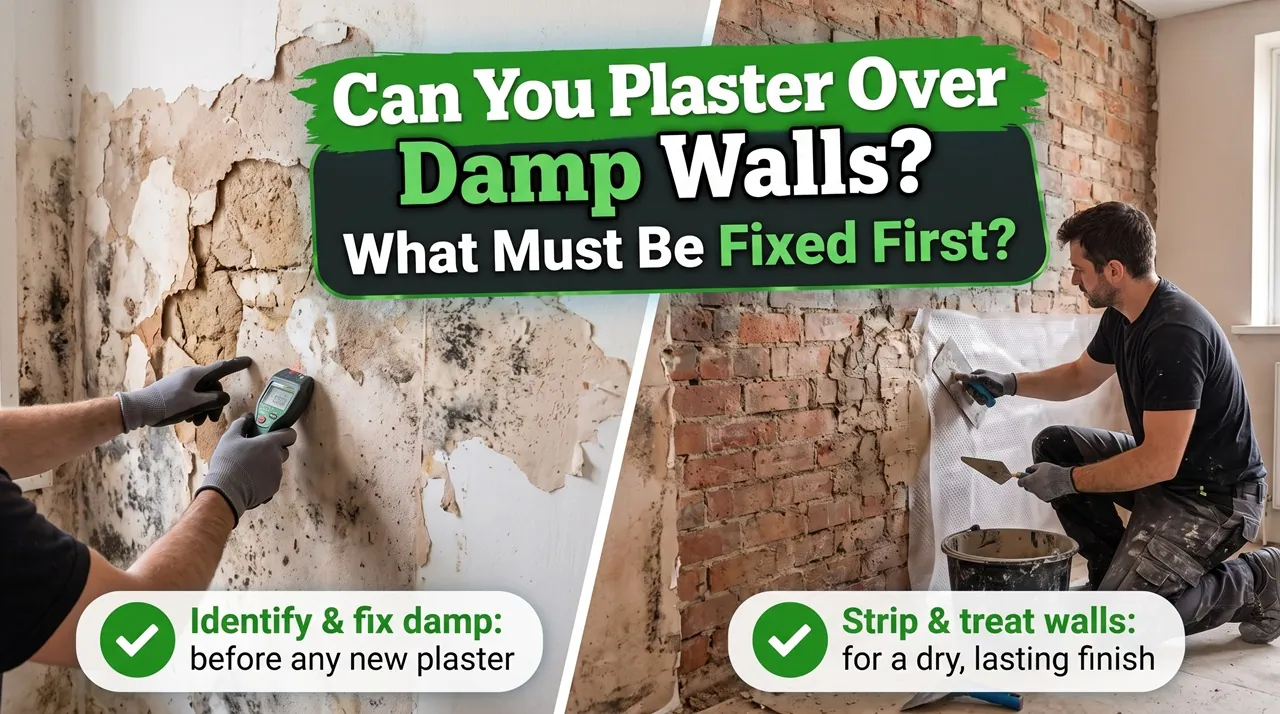
Can You Plaster Over Damp Walls?
You should not plaster over a wall that is still actively damp. New plaster does not cure the problem underneath it. Moisture keeps moving through the masonry, so a fresh finish can stain, blister or fail. Loose plaster and salts underneath make failure more likely.
Once the cause is fixed, many walls can be repaired. Some need only a local repair, while others need sections removed and replaced first. So, can you plaster over damp walls? Yes, in the right conditions, and the work often forms part of internal plastering work.
Why Does Damp Cause Problems for New Plaster?
New plaster needs a dry enough background to bond to. Moisture weakens that bond and carries salts into the finish, which can show as damp patches and blown plaster.
The damage is not always immediate, so covering damp can look successful at first. Later, the wall may stain again, and mould may return.
What Is Causing the Damp?
Internal damp usually comes from one of four sources. Each needs a different fix, so treating condensation like rising damp, or replastering over a leak, wastes money.
Rising Damp
Rising damp affects the lower part of masonry, where ground moisture moves upwards through brick or stone. It can appear where a damp-proof course has failed, is missing or has been bridged. Signs may include tide marks, low staining, white salts, known as efflorescence, and damaged skirting. One sign alone does not prove it, because leaks can look similar.
Penetrating Damp
Penetrating damp is rainwater getting through the building fabric. Entry points include cracked external render, worn pointing, leaking gutters and downpipes, roof defects, flashing and gaps around windows. The patch often grows after wet weather and can appear at any height, so the defect should be repaired first.
Condensation
Condensation forms when warm, moist air from cooking, bathing and drying clothes meets a cold wall. Poor ventilation, high humidity and thermal bridging, where part of the wall is colder, make it worse. It often shows as mould around windows and in corners.
Plumbing or Roof Leaks
A plumbing or roof leak can saturate one part of a wall. Sources include water and waste pipes, radiator connections, baths and showers. The leak must be repaired and the damage assessed first. A local repair may be enough if plaster is still bonded.
Does Damp Plaster Need Removing?
Sometimes, but not always. It depends on how far the damage goes, and tapping the surface will often show the difference. A new finish cannot repair a failed layer underneath, so removal is more likely in these cases.
- The plaster is loose, blown or hollow when tapped.
- The plaster is crumbling, detached or bulging.
- The plaster is heavily contaminated with salts.
- Staining keeps returning after the source was fixed.
Plaster may remain where it is firmly bonded, the source is resolved and salts are not a problem. There is no need to remove a whole wall for one old stain, but leaving failed plaster stores up problems for later.
Why Do Salts Matter When Replastering Damp Walls?
Salt damage follows a simple process, which explains why a wall can still look damp after the source has gone.
- Moisture moves through brick or stone, dissolving soluble salts inside the masonry.
- The water evaporates at the surface, and salts stay behind in the plaster and masonry.
- Hygroscopic salts then attract fresh moisture from the air in the room, so the surface can keep looking damp.
The Property Care Association guidance explains this behaviour. Heavily contaminated plaster may need removing, because a fresh skim over it rarely lasts, and no removal height suits every project.
Can You Skim Over a Previously Damp Wall?
Skimming can be the right finish on a wall that has had damp, but only in the right conditions. A skim is a finishing coat, not a damp treatment.
When a Skim Coat Can Work
A skim may be suitable where the source has been resolved, residual moisture has gone, plaster is stable, and salts are absent.
When Skimming Is the Wrong Choice
Skimming should not cover loose, hollow or salt contaminated plaster. The guide Skimming vs Replastering: Which Does Your Wall Need? explains the choice. The real question is not simply can you plaster over damp walls, but whether the wall underneath is ready.
What Happens After Damp Proofing?
Plastering after damp proofing depends on the specification, residual moisture, salts and the old plaster. The manufacturer instructions should be followed. Three factors decide the timing for replastering after damp proofing.
Wall thickness. Thicker masonry holds more moisture and needs longer.
Moisture level. Readings should guide the decision, not a date on a calendar.
Ventilation and season. Warm, ventilated conditions help, while cold and damp weather slows drying.
Which Plaster Is Suitable After Damp Problems?
The right plaster depends on the wall, its history and any treatment it has had.
| Plaster type | Where it can suit | Main caution |
|---|---|---|
| Gypsum plaster | Dry, suitable backgrounds | Not a cure for active damp or heavy salts |
| Lime plaster | Older solid walls where breathability matters | Not right for every damp wall |
| Renovation plaster | Walls after damp treatment, where residual salts remain | Salt-resistant system must match the treatment used |
No single product suits every wall, so the wall should be assessed first.
What About Older Durham Properties?
Older properties across County Durham often have solid brick or stone walls built with lime mortar. Many have lime plaster in one room and gypsum repairs in another.
Those materials behave differently, so compatibility matters. A repair that suits a cavity wall may not suit a solid wall, and the construction should be checked, not assumed.
How Do You Know When the Wall Is Ready for Plastering?
A wall is ready when the cause has been fixed, conditions suit the chosen system and remaining plaster is sound.
| Wall condition | Likely next step |
|---|---|
| Active damp | Find and fix the moisture source |
| Old leak, plaster sound | Assess for local repair |
| Loose or hollow plaster | Remove failed areas |
| Heavy salt contamination | Specialist replastering specification may be needed |
| Penetrating damp | Repair the external defect first |
| Recently damp-proofed wall | Follow treatment specification |
Repairing Damp-Damaged Walls in Durham
So, can you plaster over damp walls and expect the finish to last? Only when the cause, plaster condition and salts have been dealt with first.
At Plasterers Durham, assessment covers those points before local repair, skimming or replastering is recommended. If damp damaged plaster needs assessing, or you need plaster repairs in Durham, contact Plasterers Durham and describe where it appears.
Frequently Asked Questions
These are the questions homeowners ask most often about plastering a wall affected by damp.
Can You Plaster Directly Over a Damp Wall?
No. Plaster over active damp may lose adhesion, stain or blister. Fix the cause first, then assess the plaster and salts.
Can You Skim Over a Wall That Has Had Damp?
Yes, in some cases, where the cause is fixed, salts are not a problem and plaster is stable. A skim does not treat damp or cover failed plaster.
How Long After Damp Proofing Can Walls Be Plastered?
It depends on wall thickness, moisture, masonry, treatment type, ventilation and plaster system. Moisture readings should decide.
Can Gypsum Plaster Be Used After Rising Damp?
Sometimes, on a treated, dried wall. Gypsum should not hide active damp or heavy salts, and a renovation system may suit better.
Can Damp Come Back Through New Plaster?
It can appear to. If the source was not fixed, or salts and residual moisture remain, new plaster can stain. That is why the question can you plaster over damp walls is really about the wall underneath.